

Menu
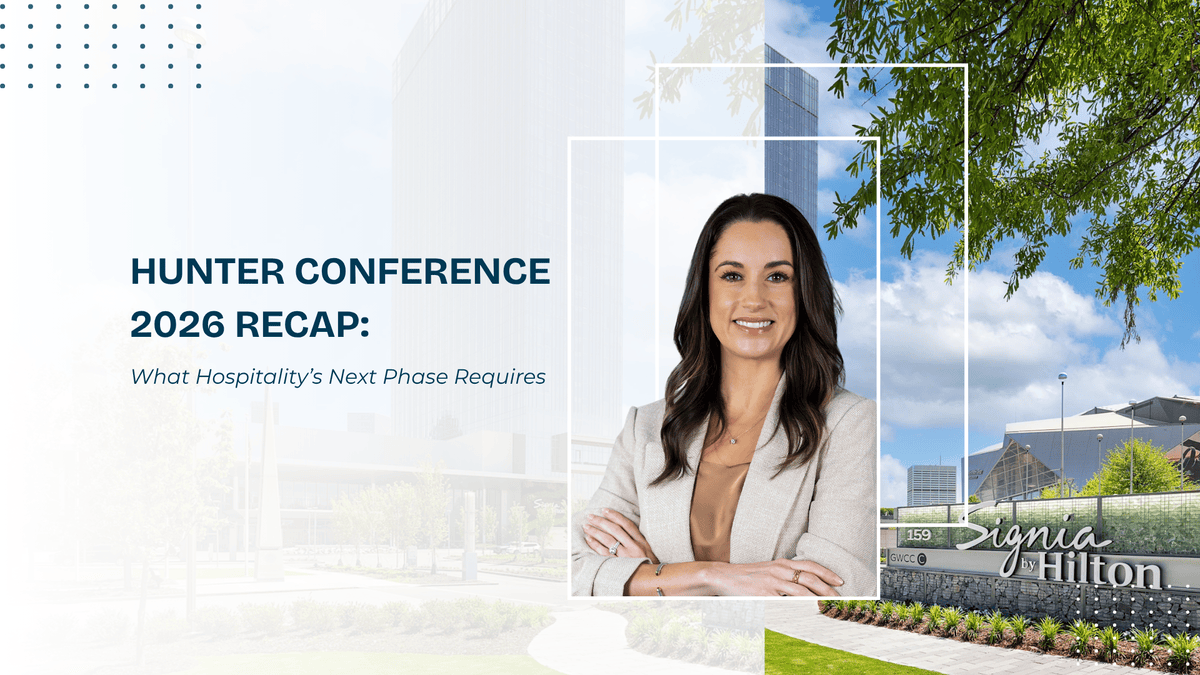
At this year’s Hunter Conference, one message came through clearly: hospitality is not short on opportunity, but it is demanding more discipline than it has in years.
The tone across the conference was constructive, but selective. Transaction sentiment is improving. Interest in hospitality remains strong. But owners, investors, developers, and operators are no longer talking about growth in broad strokes. They are talking about where growth is actually worth pursuing, how to protect NOI when margins stay tight, and what kinds of assets can still create durable value over a full hold period.
That shift made this year’s conversations especially relevant. Hunter 2026 did not point to a market that rewards expansion for the sake of scale. It pointed to a market that rewards clarity of thesis, operational depth, and long term partnership value.
1. The outlook is improving, but profitability remains the real story.
The macro picture at Hunter was cautiously better than it has been, yet hardly carefree. Supply growth remains muted, which should help the sector over time, but demand growth is still uneven and room rate growth is not cleanly outrunning inflation. In other words, topline gains alone are not solving the pressure in the middle of the P&L.
That is why so many conversations turned back to profitability. The brighter pockets of the market continue to be assets with stronger pricing power, more resilient demand drivers, and layered revenue streams beyond rooms, including luxury resorts and properties that can capture meaningful group, food and beverage, and experience-driven business. The tougher story remains in the middle, where many assets are still contending with softer demand and limited room to push rate.
For owners, this is an important distinction. A hotel does not need to chase every dollar of revenue if that revenue arrives through the wrong channels, the wrong segments, or at the expense of margin. In this environment, the question is not simply whether demand returns. It is whether revenue quality improves.
2. Capital is moving again, but disciplined underwriting is back in charge.
One of the clearest themes from Hunter was that the transaction market is finding its footing again, but no one is confusing renewed activity with easy money. Cost of capital, construction pricing, and lender selectivity are still forcing every deal to stand on a much sharper financial case.
That reality is keeping new development highly selective. Across multiple sessions, the consensus was straightforward: new construction can still work, but it often requires a longer hold horizon, more equity, tighter cost control, and a very clear understanding of what the market can support. Repositionings, conversions, and acquisitions of existing assets continue to look more practical in many cases, especially when the real estate is sound but the commercial strategy, operational execution, or product positioning still leaves value on the table.
That framing matters because it shifts the conversation from chasing trends to identifying where a platform can create real advantage. The best opportunities are not always the newest ones. Increasingly, they are the assets where thoughtful reinvestment, disciplined brand selection, and better revenue infrastructure can unlock value that was already there.
3. Revenue growth is no longer enough. Revenue quality matters more.
Another strong signal from Hunter was that owners are looking much more closely at how revenue is earned, not just how much of it shows up on the top line.
Channel mix came up repeatedly, and for good reason. Direct business, loyalty contribution, and brand.com economics continue to matter disproportionately in a margin constrained environment. When acquisition costs are high, overreliance on third-party channels can quietly erode profitability even when headline ADR looks healthy. That is why a smarter commercial strategy today means looking past RevPAR in isolation and asking what that revenue is actually worth once the costs to capture it are accounted for.
This is also where operational visibility becomes more important. Owners want cleaner reporting, faster decision making, and better line of sight into where profit is being created or lost. The management groups that stand out in this environment are the ones that combine revenue strategy with financial discipline, not the ones that optimize occupancy at any cost. In a market like this, operators are being asked to act more like stewards of capital, not just managers of rooms.
4. Food and beverage has moved closer to the center of the value story.
Hunter also reinforced something that has been building across hospitality for several years: food and beverage is no longer a side conversation. It is increasingly part of how resorts and hotels differentiate themselves, build local relevance, and expand total revenue beyond the room.
The most compelling conversations were not about adding complexity for its own sake. They were about creating concepts that feel intentional and right for the market. That can mean smaller, more flexible group experiences. It can mean coffee bars that function as community anchors. It can mean restaurant identities that attract local traffic, extend guest spend across the stay, and even create retail or experiential follow ons.
The deeper takeaway is that owners should think in total revenue terms, not just room revenue. In a market where room margins remain under pressure, hotels that can create multiple high quality spend occasions on property have a meaningful advantage. That is especially true in resort and leisure environments, where dining, programming, and social spaces are often inseparable from the guest experience itself.
5. Culture and leadership still separate good assets from great ones.
For all the discussion around capital markets, channels, and technology, one of the most practical reminders at Hunter was that hospitality is still a people business layered on top of real estate.
That idea showed up repeatedly in the Main Street conversations. The best performing hotels are rarely winning on spreadsheet logic alone. They are often the ones with stronger on-property leadership, better team engagement, and higher guest satisfaction. In a transparent review environment, that difference is visible to the market almost immediately. The gap between a good guest score and a mediocre one can translate directly into pricing power, conversion, and long term asset performance.
This matters for investors and owners because culture is not a soft topic. It is an operating lever. Leadership quality influences service consistency, labor stability, guest experience, and ultimately the financial resilience of the property. In a period when many hotels are fighting for every point of margin, that connection becomes even more important.
6. Technology and brand strategy are most valuable when they solve real owner problems.
AI was present at Hunter, as expected, but the most useful conversations were refreshingly practical. The focus was less on novelty and more on visibility, efficiency, and speed. How do you pull together financial and operational data more clearly? How do you give owners better transparency? How do you reduce friction in the back office and improve decision making without losing the human side of hospitality?
That same pragmatism showed up in the brand conversations as well. Brand alignment still matters, especially as visibility, distribution, and digital discovery continue to evolve. But the real issue is whether brand standards, renovation cycles, and commercial tools are helping owners strengthen returns over the life of the asset. The strongest partnerships are the ones that balance guest facing consistency with real flexibility around capital planning, conversions, and long term strategy.
In other words, technology and brand affiliation are not ends in themselves. They are tools. Their value is measured by whether they improve owner outcomes.
Closing Thoughts
If Hunter 2026 had a defining message, it was this: hospitality is still full of opportunity, but this is a market that rewards intention.
Owners are not just operating hotels. They are managing investments. Developers are not just building projects. They are underwriting long term operational realities. Management companies are not just responsible for topline growth. They are expected to protect margin, create visibility, and act as true partners in the value of the asset.
The next phase of hospitality will not be defined by who grows fastest. It will be defined by who grows smartest. That means disciplined capital, sharper commercial strategy, stronger leadership, and a clearer focus on the asset types and markets where operational depth can create measurable advantage.
Connect with us to explore our management strategies.