

Menu
At Brittain Resorts & Hotels, our approach to technology in restaurants is rooted in a simple philosophy: automation should absorb the work that pulls our people away from guests, and never touch the work that puts them in front of guests. Hospitality is a human business. The goal of AI in our restaurants has never been to replace that humanity; it has been to protect it.
That distinction matters, because the loudest conversations about AI in food and beverage tend to start in the wrong place. They start with the technology and then look for a problem it can solve. Our team started with the problem. Walk into any high-volume restaurant at 6:30pm on a Saturday night and you can watch it happen: the phone rings, and someone has to choose. Answer it, and a guest standing three feet away waits. Let it ring, and a guest you cannot see gives up and books somewhere else. For decades, operators have simply accepted that choice as the cost of doing business. We decided to stop accepting it.
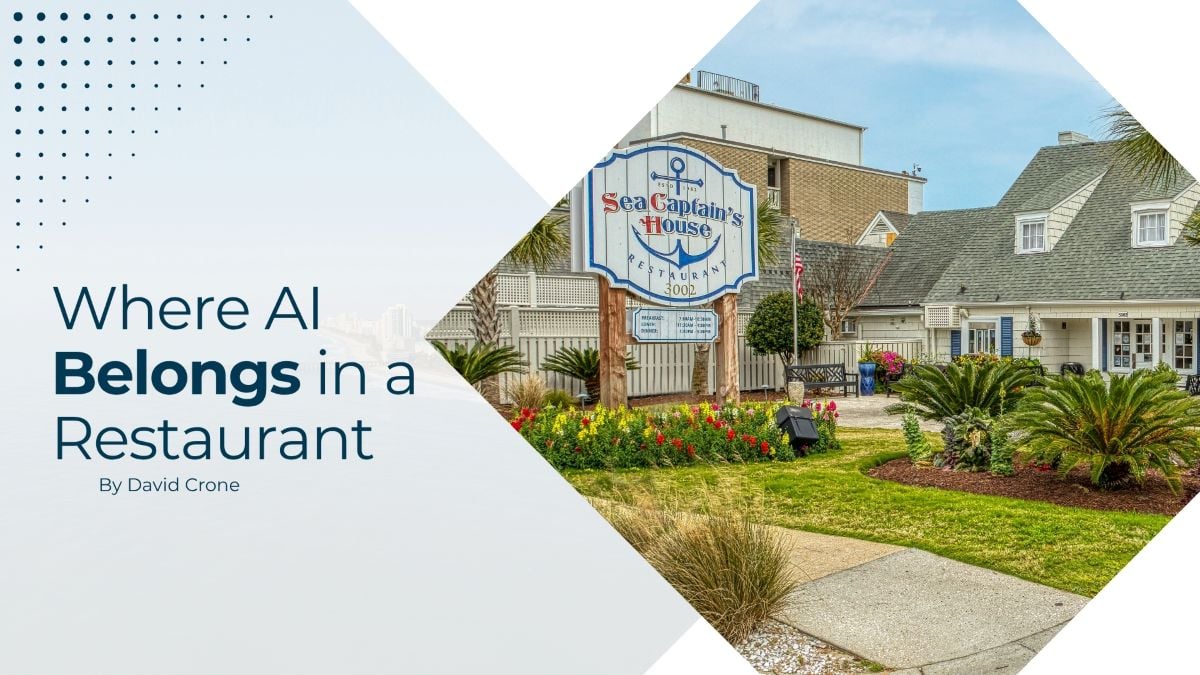
At Sea Captain’s House, our landmark oceanfront restaurant in Myrtle Beach, we introduced an AI phone assistant our team knows as Angie. She answers every call, every time, during the dinner rush, between seatings, and after the lights go out. She books reservations directly into our reservation system, sends text confirmations, answers questions about hours and menus, and hands callers to a person when a person is what the moment requires.
The results reframed what we thought a phone line could do.
Angie now handles roughly 230 calls a day at a single restaurant, about seven thousand a month. Nearly half of those calls are guests trying to book a table, and the heaviest volume arrives during the peak dinner window, precisely when our hosts are needed most on the floor. She books hundreds of reservations a week directly into our reservation system, confirms them by text, and captures the calls that come in after close, which used to be lost demand by definition.
The most valuable thing AI has given our restaurants is not data or efficiency. It is the ability for our people to be more present with our guests while technology handles the interruptions.
Then there is the labor. The phone traffic Angie absorbs represents around fifty hours of talk time every week, or more than 2,500 hours a year at a single restaurant. Those are hours our team no longer has to spend managing calls from the host stand, in a market where every labor hour is precious. In a seasonal destination like Myrtle Beach, where staffing needs fluctuate significantly throughout the year, that flexibility is not a luxury. It means our team members spend their shifts greeting guests, managing the floor, and delivering the experience people drive hours for, instead of repeating our hours of operation for the fortieth time that day. Our restaurant managers, who once spent meaningful parts of their day entering phone reservations, have that time back for coaching and hospitality.
What surprised us most was quality.
Every call is transcribed, reviewed, and scored, which means for the first time we can actually hear our phone experience at scale. Guest sentiment runs overwhelmingly positive, and when a call goes sideways, our managers know it that day, not months later in an online review. The phone went from our least visible guest touchpoint to our most measurable one.
None of this happened because a piece of software showed up. It happened because our operators made it work. The system had to learn our restaurants: how we handle large parties, when a caller truly needs a manager, how to offer an alternate time gracefully when the 7:00 slot is gone. Getting the handoff between AI and staff right took real iteration from the team at Sea Captain’s House, and we are still tightening it. Any operator who tells you AI is plug-and-play has not deployed it during a summer weekend on the Grand Strand.
This is not an isolated experiment.
Brittain has spent years building more data-informed operations, from our business intelligence platform to intelligent reservation management. Voice AI is the next step in that evolution, not a departure from it. As it proves itself, our intent is to carry what we have learned at Sea Captain’s House across our restaurant portfolio, the same way we approach every operational standard: prove it at one property, refine it with the team, then scale it.
Looking ahead, we believe the restaurants that win with AI will be the ones that deploy it with discipline. The technology is advancing faster than most operations can absorb, and the temptation is to automate everything that can be automated. That is the wrong test. The right test is whether the technology creates more space for human hospitality, not less. Voice AI on the phone line, intelligent reservation management, and demand forecasting behind the scenes pass that test. Anything that puts a screen where a smile belongs does not.
For F&B leaders evaluating where to start
Our advice is simple: find the moments where your people are forced to choose between serving the guest in front of them and handling an operational interruption. Give the interruption to the machine. Measure everything. Hold the technology to the same standard you hold a new hire. It should make the room warmer, not colder. And involve your team early, because adoption is won at the host stand, not in the boardroom.
Ultimately, integrating AI into restaurants is not a technology decision. It is a hospitality decision. The tools will keep changing. Our obligation to the guest in front of us, and the one on the phone, will not.
Want to learn how Brittain Resorts & Hotels creates experiences that turn guests into lifelong advocates? Connect with us to explore our guest-centric management approach.